How to Use a Workout Tracker for Better Training Results
A workout tracker is more than a place to store sets and reps. It is a decision system. When you log sessions consistently, you stop relying on memory and start seeing patterns: where progress is happening, where fatigue is accumulating, and where your plan needs to change. This guide shows what to track, how to review your logs, and how to turn data into action without overcomplicating the process.
What a workout tracker should capture
The base layer is simple: exercise, sets, reps, load, and rest. That gives you a usable performance history. The next layer is context: effort (RIR/RPE), session quality, and any execution notes that affect progression. For hypertrophy, execution quality matters. If load rises but range of motion shrinks, the data can mislead you. Your tracker should let you connect numbers to execution.
Keep the process frictionless. If it takes too long to log, compliance drops. Use templates for recurring sessions and keep note fields short. The best tracker is the one you can use every session, not the one with the most fields.
Why consistent logging improves progress
Training adaptation happens over weeks, not individual sessions. Without logs, people often repeat similar loads and call it hard training, but overload never compounds. Consistent data lets you spot real trends: rep PRs on stable technique, better tolerance to volume, and where fatigue is suppressing performance.
It also improves recovery decisions. If performance dips across multiple lifts while effort stays high, you can reduce volume or add recovery before a deeper stall happens. Tracking does not remove intuition; it sharpens it with evidence.
How to apply your logs each week
Run a short weekly review. First, check your key lifts and ask whether you progressed in reps, load, or execution quality. Second, check session consistency and missed workouts. Third, identify one bottleneck to fix next week: sleep, exercise order, or total sets. Keep changes small so cause and effect remain clear.
If a lift stalls for two to three exposures, change one variable at a time. For example, keep load stable and push reps, or reduce set count and improve quality. Your tracker should make these small experiments visible.
A workout log you can use next session
Here is a fictional bench press entry. Record what you completed, including the last set that fell short. Keep the exercise setup and rest consistent so the comparison means something.
| Set | Load | Reps | Context |
|---|---|---|---|
| 1 | 175 lb | 8 | Controlled reps; 2 min rest |
| 2 | 175 lb | 8 | Same setup; 2 min rest |
| 3 | 175 lb | 7 | Stopped before technique changed |
Next-session decision: repeat 175 lb and aim to complete the third set for 8 comparable reps. If the warm-up feels unusually difficult, adjust the target instead of forcing the number. This is a manual example; JAKD's suggested target depends on your own exercise history.
The log contains 23 reps and 4,025 lb of volume load (175 × 23). That total describes work recorded for this lift. It does not measure muscle growth or replace a set-by-set review. Once the entries are consistent, use the double-progression example to plan how reps and weight can change.
Keep your baseline beside your next set
In JAKD, the active-workout carousel keeps one exercise in focus. Your last session, PR, and suggested weight-and-reps target sit beside the sets you log. Targets appear once that exercise has history.
Workout logging is free. Keep any extra recovery or physique records separately; the screenshot shows the workout log.
See the workout carousel and feature access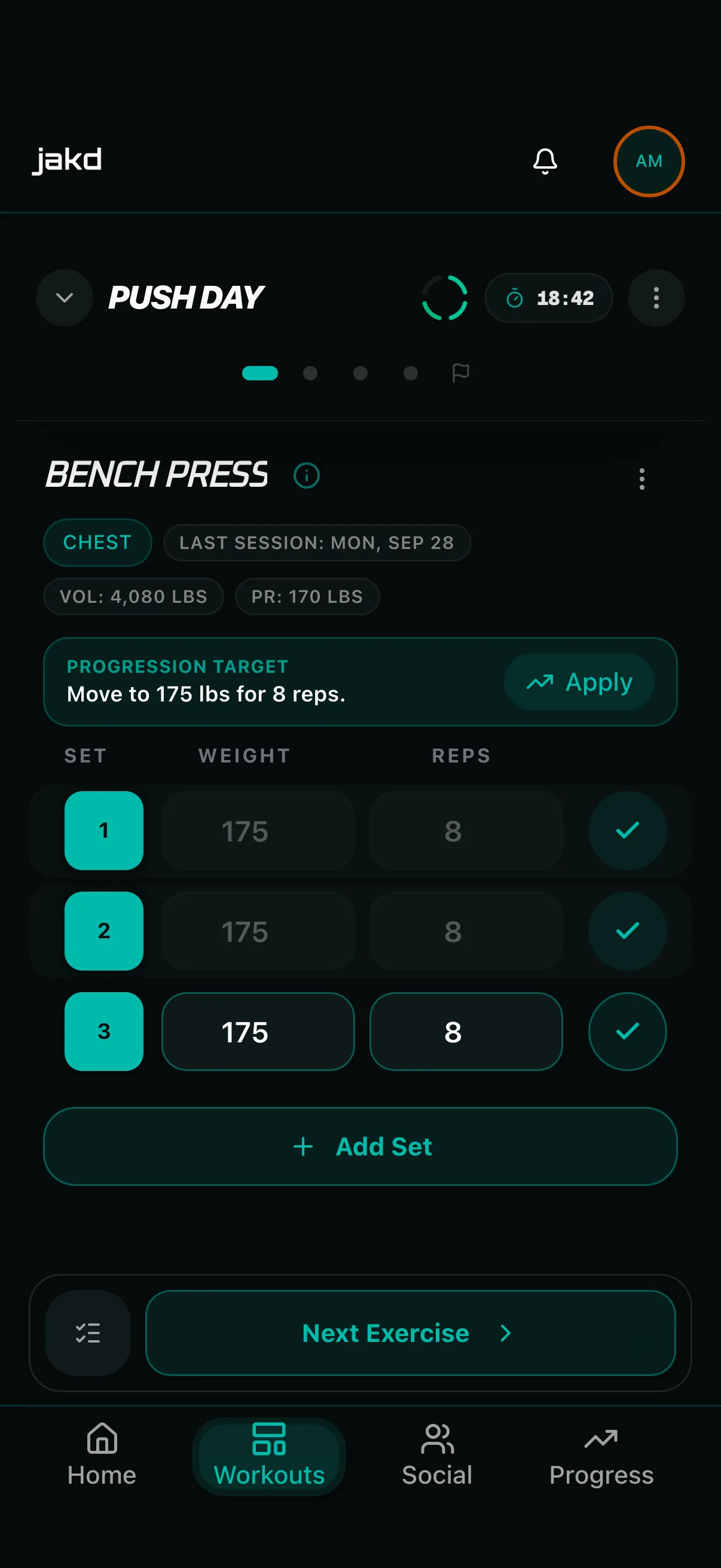
Weekly checklist
- Log every working set with reps, load, and rest.
- Add short effort and technique notes on key lifts.
- Review one-week and four-week performance trends.
- Choose one overload target for next week.
- Adjust only one variable at a time when stalled.
Related guides
Sources and further reading
These training references inform the principles in this guide. The worked examples are illustrative decisions, not study results or a personalized program.
- ACSM position stand: Resistance Training Prescription for Healthy Adults (2026). Evidence on training variables, progressive overload, and individualizing a program.
- IUSCA position stand: Resistance Training Recommendations for Muscle Hypertrophy (2021). Training considerations and the distinction between strength and muscle size.
FAQ
What should I track in a workout tracker?
Track exercises, sets, reps, load, and rest times first. Add effort notes like RIR and short comments on technique so you can make better decisions week to week.
How often should I review my workout log?
Review your log once per week. Weekly reviews are frequent enough to catch stalls early but not so frequent that day-to-day noise leads to overreacting.
Can beginners benefit from detailed tracking?
Yes. Beginners improve quickly, and tracking helps confirm what is working. You can start simple and gradually add detail as your training age increases.
What is the biggest logging mistake?
The biggest mistake is inconsistent entries. If you skip logs for hard sessions or forget set details, you lose the baseline needed for progressive overload.
Should I track bodyweight with workouts?
Yes, but treat bodyweight as context rather than the primary score. Combine it with performance trends, recovery, and measurements for better decisions.
Turn your training data into momentum
Jakd helps you log faster, review progression, and stay consistent with your training crew.