Progressive Overload for Real-World Training
Progressive overload is often reduced to one rule: add weight every week. In practice, muscle growth requires a more flexible system. Some weeks you add load. Other weeks you add reps, improve execution, or manage fatigue so the next block can progress. This guide explains how to overload consistently without forcing unsustainable jumps.
What progressive overload really means
Overload means increasing the stimulus your body must adapt to. Load is one method, but not the only method. If you perform more reps at the same weight with similar effort, that is progress. Improved depth and control are useful technique changes, but they also change the comparison. Record them rather than assuming the numbers are equivalent. The key is comparable execution.
Hypertrophy responds to tension and repeatable effort. Your progression model should reward improvements that preserve movement quality, not just heavier numbers.
Why lifters stall despite hard work
A stall can have several causes, including inconsistent comparisons and changes in recovery. If you do not know your recent performance baseline, it is easy to repeat the same training load while assuming you are progressing. On the other side, lifters can push every set to failure and accumulate fatigue faster than they can recover. Performance then falls, even with strong effort.
Good overload balances pressure and recoverability. You need enough challenge to force adaptation, but not so much chaos that quality and adherence collapse.
How to apply overload week to week
One practical option is to build reps within a range, then increase load. For example, if your target range is 8-12 reps and you hit 12 with clean form at your current load, increase weight slightly and rebuild through the range. If load does not move, drive rep quality and consistency instead. If both stall, consider a modest volume bump or exercise tweak.
Evaluate performance over at least two to three exposures before calling a stall. Daily variance is normal. Trend lines matter more than single sessions.
Double progression: a worked example
Choose a rep range that fits your program. In this fictional example, a lifter uses 3 working sets of 8–12 reps on the same chest-press machine. They keep the setup, range of motion, and rest consistent, build reps, then increase load after reaching the top of the range.
| Session | Load | Reps by set | Next decision |
|---|---|---|---|
| 1 | 100 lb | 10 / 9 / 8 | Keep load; build reps |
| 2 | 100 lb | 11 / 10 / 9 | Keep load; build reps |
| 3 | 100 lb | 12 / 12 / 12 | Consider a small load increase |
| 4 | 105 lb | 10 / 9 / 8 | Rebuild through the range |
The fourth session has fewer reps because the load increased. That is a new baseline, not automatically a setback. The 5 lb step and rep range illustrate one approach; they are not a universal rule or JAKD's target algorithm. Use an increment you can control and check the pattern across sessions.
If session 3 had been 12 / 10 / 8, this example would keep the load stable. If reps fell for several sessions, review rest, technique, and recovery before adding more work. Start with a consistent workout log so those comparisons are usable.
The 2026 ACSM position stand describes increasing training stimulus over time and adapting programs to the individual. It also finds that reaching muscular failure is not required for benefits. A progression target should guide a decision, not demand a PR in every workout.
Bring the last session into this one
JAKD shows your last session and PR in the active workout. With exercise history, you can apply a suggested weight-and-reps target in one tap, then log what actually happened.
Free workout logging. The screen uses fictional data and illustrates a different lift from the table above.
Explore last-session targets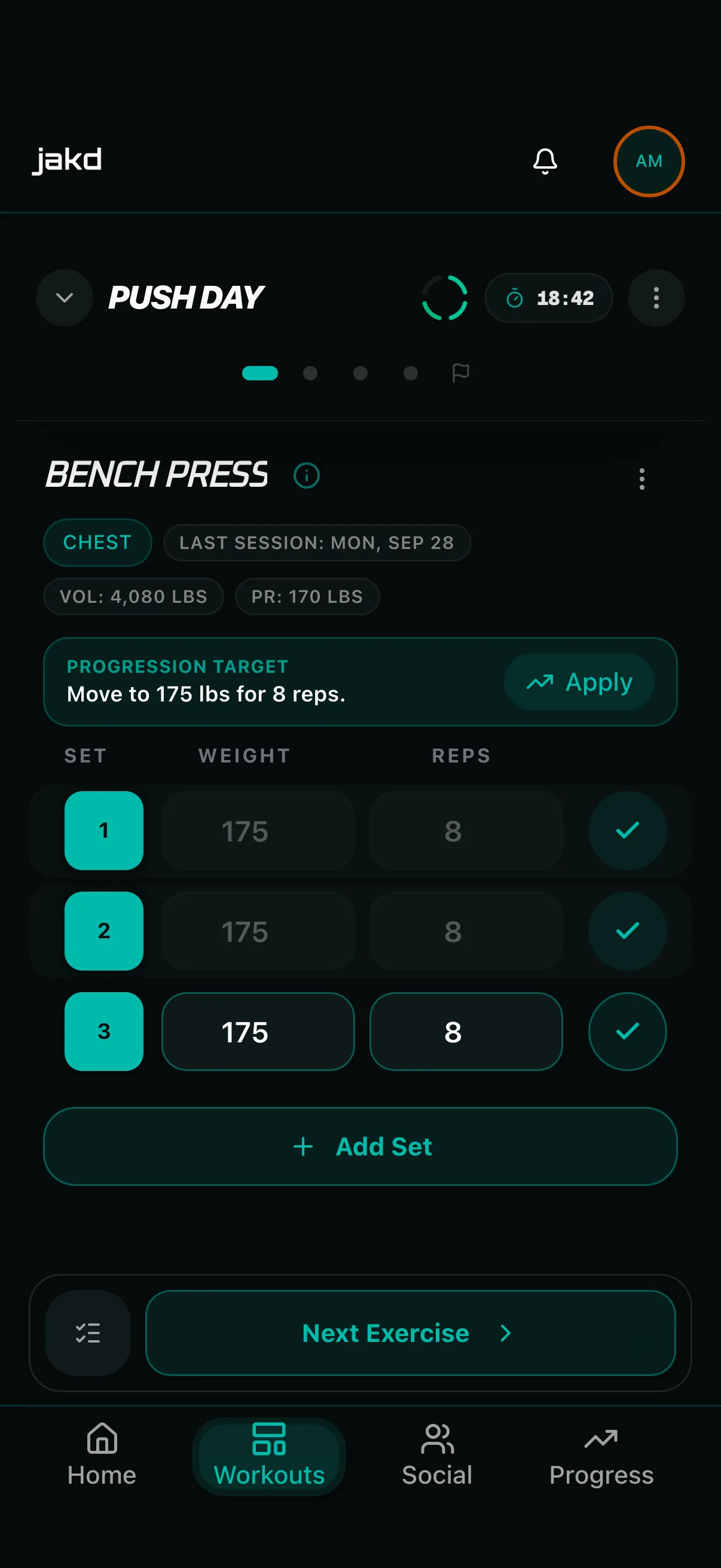
Overload checklist
- Set a rep range for each main lift.
- Progress reps before adding load when quality is inconsistent.
- Increase load only after clean top-end reps.
- Track effort so fatigue trends are visible.
- Adjust one variable at a time when stalls appear.
Related guides
Sources and further reading
These training references inform the principles in this guide. The worked examples are illustrative decisions, not study results or a personalized program.
- ACSM position stand: Resistance Training Prescription for Healthy Adults (2026). Evidence on training variables, progressive overload, and individualizing a program.
- IUSCA position stand: Resistance Training Recommendations for Muscle Hypertrophy (2021). Training considerations and the distinction between strength and muscle size.
FAQ
What counts as progressive overload?
Progressive overload means increasing training demand over time through load, reps, sets, density, or execution quality while keeping movement standards consistent.
How fast should I add weight?
Add weight only when you hit your target rep range with clean technique and stable effort. Many lifters progress better with smaller, more frequent increases.
Can I overload without adding load?
Yes. You can add reps, improve range of motion, reduce rest slightly, or add a set if recovery supports it. Load is only one progression tool.
What if my lifts stall for multiple weeks?
When stalled, change one variable at a time. Reduce fatigue, adjust volume, or swap the lift variation while preserving the movement pattern.
Should every session be harder than the last?
No. Day-to-day performance fluctuates. Focus on trend lines across multiple exposures, not forcing a PR every session.
Build progression into every session
Jakd helps you track overload signals clearly so your plan evolves with your actual performance.